
What to include on your wedding website (UK guide)
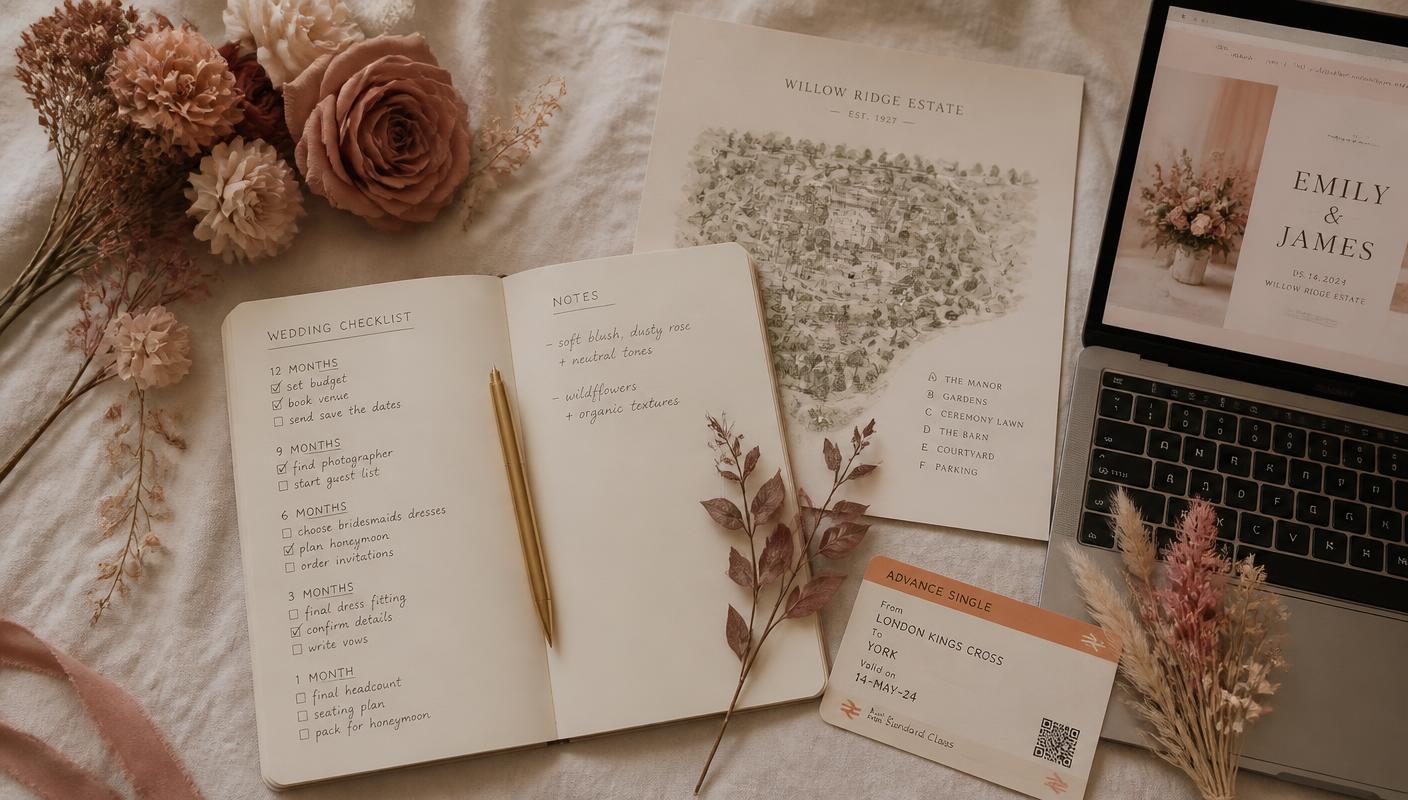
A wedding website has one job: to answer, calmly and in one place, every practical question a guest will otherwise text you at 11pm. This guide sets out what to include, section by section, with the source behind each recommendation.
One thing worth saying at the start. Plenty of wedding-website advice is presented as though it were measured guest behaviour. Much of it isn’t — it’s editorial consensus from platforms that also sell planning products. Where the evidence is strong we say so; where it is opinion, or American, or simply missing, we say that too.
What information do wedding guests need most?
Across current UK guidance from Bridebook [1] and Hitched [2], the same eight areas recur. Read this as editorial consensus, not a ranked survey: we found no UK study that ranks guest questions by frequency, so nobody can honestly tell you which of these matters most.
- Exactly when and where — date, ceremony and reception addresses, arrival time, start time and the finish or “carriages” time.
- How to get there and home — postcode, map, the correct entrance, parking, nearest station, taxis, shuttles and transport between venues.
- Where to stay — options, a room-block link or code, the booking cut-off and distance from the venue.
- What to wear — what the dress code actually means, indoor or outdoor, footwear, weather and terrain.
- Who is invited — named guests, plus-ones, children, and which events each guest may attend.
- How to respond — RSVP method, deadline, meal choice, dietary and allergy information, and how to change an answer.
- What to expect — rough schedule, food format, bar arrangements, accessibility, photography policy and a contact.
- Gifts — whether gifts are expected, and a direct link to a gift list, honeymoon or cash fund, charity option, or a plain “no gifts”.
Bridebook frames the relationship neatly: the invitation carries the headline details — names, date, time, venue name — while the website carries the full picture, including the schedule, address and map, parking, accommodation, dress code, RSVP, gift list, travel, FAQ, your story and photographs [1]. Hitched’s FAQ list adds finish time, bar arrangements, indoor/outdoor plans, plus-ones, children, food, transport and a second contact [2].
The essential wedding website sections
These are the standard sections, and what each one should actually contain. A guest-first order puts attendance-critical pages first, practical planning second and personal storytelling last — mirroring Bridebook’s essentials-and-extras distinction [1] and Hitched’s emphasis on logistics and FAQs [2].
| Section | What it should contain |
|---|---|
| Homepage | Names, full wedding date, location or venue, a concise welcome and a prominent RSVP button. Bridebook recommends names and date be immediately visible [1]. |
| Our story | How you met, an early memory, the proposal, a few photographs. Personal content — not the place for logistics. |
| Schedule / timeline | Guest arrival time, ceremony, drinks, wedding breakfast, evening reception, finish time, plus welcome drinks or next-day brunch. Enough to plan around, not a supplier run-sheet. |
| Venue and travel | Full venue names and addresses, postcode, clickable map, separate ceremony/reception locations, the correct entrance, driving notes, parking availability and cost, and transport between venues. |
| Accommodation | Room-block hotel with a direct booking link or code, the booking deadline, alternatives at several price points, distance or journey time to the venue, and whether venue rooms are restricted to the wedding party. |
| Dress code | A formality label plus a plain-language interpretation, indoor or outdoor setting, ground surface, footwear restrictions, likely weather, and optional colour guidance. |
| FAQ | RSVP method and deadline, children, plus-ones, arrival time, parking, accessibility, accommodation, dietary requirements, gifts, phone and photo policy, bar arrangements and a day-of contact. |
| RSVP | Attendance for each invited event, a clear deadline, guest and plus-one names, child attendance where permitted, meal selection, allergies and dietary needs, and optional transport and accessibility requirements [7]. |
| Gifts / gift list | Direct links, a clear statement if gifts are optional, and traditional gift, charity, honeymoon or cash-fund choices. Guests shouldn't have to hunt back through messages for the link. |
| Gallery | A small number of clear relationship or engagement photographs before the day; more afterwards. Avoid imagery that buries the practical content. |
| Accessibility | Step-free routes, accessible parking and drop-off, lifts, toilets, seating, quiet space, hearing or visual support, surface conditions, accessible transport, and a private way to request an adjustment. |
| Contact and updates | A dedicated email, planner or nominated wedding-party contact, clearly dated urgent updates, and an alternative route for guests who can't use the RSVP form. |
| Privacy | Password protection where available. Don't publish home addresses or unnecessary guest data, and keep invitation-specific events off universally visible pages. |
Every one of these sections — accessibility and multi-event handling included — comes built in as standard on our packages.
What to put on your wedding website homepage
Five things, and nothing that competes with them: your names, the full wedding date, the location or venue, a short welcome, and a prominent RSVP button. Bridebook specifically recommends that names and date be visible immediately, without scrolling or hunting [1].
A guest arriving from a save-the-date wants confirmation they’re in the right place and a route to the thing they came to do. Save the atmospheric full-screen imagery for below that point.
How to write your schedule and venue information
Two times, not one
Give the guest arrival time and the ceremony time as two distinct, clearly labelled times [2]. “2pm” on its own makes some guests arrive as the bride does.
The finish time — and why it matters
Publish the finish or “carriages” time [2]. In the UK this is practical rather than formal: guests may need a pre-booked taxi or the last train, and neither can be arranged on the night at a rural venue.
Addresses, entrances and maps
State clearly whether the ceremony and reception are at the same venue [2]. Give full addresses and postcodes with clickable maps, and name the correct entrance and drop-off point — large estates and churches often have more than one, and a postcode alone can send a car to a service gate [1].
Bar arrangements
Say whether the bar is free, part-hosted, cashless or unable to take cards. Hitched notes that the open-bar expectation is more strongly associated with US weddings than UK ones [2] — so a guest who assumes one may arrive without a card or cash.
UK travel, train, taxi and parking details to include
For a UK wedding, cover the whole journey rather than just the destination:
- The nearest railway station, and how a guest gets from that station to the venue
- Whether a taxi is likely to be needed, and whether it must be booked in advance
- The last practical return option — final train or final taxi
- Shuttle times, if you’re providing transport
- Accessible station information for guests travelling by rail
Link to National Rail’s live journey planning, station accessibility information and Passenger Assist rather than copying a timetable onto your site [10]. Timetables change; a link doesn’t go stale in the way a pasted departure time does.
Parking
State whether parking is on-site, free, paid, limited or permit-controlled, and whether it suits Blue Badge holders. Identify the correct vehicle entrance and drop-off point, and flag unsuitable surfaces — gravel, grass fields, steep unlit tracks [1].
Rural venues deserve an explicit sentence. Where taxis are thin on the ground, say plainly that guests should pre-book or use an organised shuttle.
How to present accommodation options
- The room-block hotel, with a direct booking link or code — not just a hotel name
- The booking deadline, stated as a date
- Alternatives at several price points, so guests aren’t forced into one tier
- Distance or journey time to the venue for each option
- Whether rooms at the venue itself are restricted to the wedding party
That last point avoids a common awkwardness: a guest who assumes they can stay on-site, and finds out late that they can’t [1].
Dress code, children, plus-ones and other FAQs
Dress code
Give the formality label and a plain-language interpretation of it — plenty of people genuinely don’t know what “black tie optional” asks of them. Then add the practical detail: indoor or outdoor, the ground surface (grass, gravel, cobbles), any footwear guidance, and the likely weather [1].
Children and plus-ones
State eligibility clearly, and make sure it matches both the invitation and the way your RSVP form is configured. Mismatches here are the source of the awkward direct conversation nobody wants to have [2].
The fuller FAQ list
Hitched’s current FAQ guidance covers [2]:
- RSVP method and deadline
- Parking
- Accessibility
- Accommodation
- Dietary requirements
- Gifts
- Phone and photography policy
- A day-of contact who isn’t the bride or groom
What your wedding RSVP form should ask
- Attendance for each invited event, rather than one blanket yes or no
- A clear deadline
- Guest and plus-one names
- Child attendance, where children are invited
- Meal selection, if your caterer needs it
- Allergies and dietary needs
- Optional transport and accessibility requirements
On the form itself, the strongest evidence available is the W3C’s forms guidance [7]: keep forms short, group related questions, use explicit labels and instructions, give clear and useful error messages, and confirm completion unambiguously. That is a published standard rather than editorial opinion, which is rare in this subject area — it’s worth following closely.
Gift lists, cash funds and UK wedding etiquette
UK sources say “gift list”; US platforms say “registry”. The language matters less than the framing, but copying US registry wording unchanged tends to read as blunter to a British guest than it does to an American one.
UK options now span:
- Physical gifts
- Honeymoon funds
- Cash funds
- Experiences
- Charity donations
Starling highlights continuing British discomfort around direct cash requests, and reports couples using hybrid lists to accommodate different family and cultural expectations [12]. The same article notes that attending a UK wedding cost guests £451 on average, including £108 for a gift — figures linked to 2024 Experian research, so now more than two years old [12].
A figure you will see misused
Zola’s widely quoted finding that 86% of couples consider cash funds acceptable comes from a US survey of 11,500+ engaged couples [13]. It is not a UK statistic and shouldn’t be presented as one — the same survey’s 87% for child-free weddings and 91% for unplugged ceremonies carry the same caveat.
We could find no reliable UK-specific figure for cash-gift acceptance. What exists is editorial guidance rather than data: explain what a contribution supports, make giving clearly optional, and offer alternatives.
How to make a wedding website accessible
The website itself
- Semantic headings, descriptive link text, and alt text on informative images
- Never communicate meaning by colour alone, and avoid images of text
- At least 4.5:1 contrast for normal text and 3:1 for large text, the WCAG Level AA minimums [6] — bearing in mind a thin font can pass numerically and still be hard to read
- Full keyboard operability with a visible focus indicator, and form fields with programmatically associated labels [7]
- Short forms, grouped questions, clear instructions, useful errors, a clear success message, and no unnecessary time limits [7]
- Testing on phones and at high zoom — W3C confirms mobile accessibility is covered by WCAG, including small screens, touchscreens, speech input and bright-light use [8]
- Plain language, short paragraphs, predictable navigation and descriptive headings; GOV.UK recommends simple language because it supports users with cognitive and learning disabilities [9]
The event and the venue
Publish confirmed information — not assumptions — on [11]:
- Step-free access, internal steps and lifts
- Accessible toilets
- Accessible parking and drop-off
- Wheelchair space and sightlines
- Quiet spaces and seating or rest opportunities
- Lighting and sound warnings
- Hearing or visual support
Add a private RSVP question asking whether a guest needs an adjustment — phrased around the practical support they need, not a request for a diagnosis [11]. Where guests travel by rail, link National Rail’s station-access information and Passenger Assist [10].
What couples commonly forget
| Omission or mistake | Consequence |
|---|---|
| Missing arrival time, finish time or separate venue addresses | Guests arrive at the wrong time or place, or can’t plan the journey home [2]. |
| Missing parking, station, taxi or shuttle details | Generates avoidable questions and leaves guests unable to plan transport confidently [1], [2]. |
| Unclear children or plus-one rules | Misunderstandings and awkward direct conversations; eligibility should match both the invitation and the RSVP configuration [2]. |
| Missing or unclear RSVP deadline and instructions | Responses are harder to collect before venue and catering numbers are due; broken links and forms lose replies outright [2], [7]. |
| No dietary or allergy question | You lack what you need for meal planning; Enhance the UK treats dietary provision as part of inclusion [11]. |
| Missing accommodation booking deadline | Guests may miss the room block. Widely asserted [1], though we found no UK room-availability dataset to quantify it. |
| Vague accessibility labelling | A generic “accessible” tells a guest nothing about parking, entrances, toilets, rooms or departure transport [11]. |
| Leaving outdated information live | Guests act on an old time, venue or travel plan. Bridebook recommends updating the site as plans change [1]. |
| Confusing navigation, or storytelling that crowds out logistics | Hitched reports that thin information and confusing design produce confused guests and more questions, while oversharing obscures the site’s purpose — from a 2021 article, so treat it as older editorial advice [4]. |
| Publishing exclusive-event details to everyone | Guests not invited to those events feel excluded; use private event visibility or separate communications [1]. |
When to launch and update your wedding website
There is no single agreed timeline — but there is a range that providers broadly recommend, in five stages:
- Once date and venue are confirmed: publish a minimal site — names, date, location, basic travel and accommodation guidance.
- Before or with your save-the-dates: share the URL. Bridebook suggests ideally before the save-the-date [1]; Joy says launch with it [5]; Hitched’s detailed timeline starts site-building 10–12 months out [3].
- With formal invitations: full addresses, schedule, dress code, accommodation, FAQ and a working RSVP should all be live [1].
- Four to six weeks before: close RSVPs, unless your venue or caterer contract demands otherwise, and verify transport, access, guest requirements and accommodation details [3], [5].
- Final weeks: update changed details prominently rather than assuming guests will revisit [1].
The sources genuinely disagree on the exact windows, and we’d rather show that than pick one number. Hitched gives save-the-dates at 8–10 months in one place and 6–12 months in another, and invitations at 6–8 weeks traditionally, “preferably around 12 weeks” where travel and accommodation are involved, and 2–3 months in its summary timeline [3]. Joy recommends save-the-dates at 8–12 months and invitations at 2–4 months [5].
None of these are observed averages; they are recommendations. Your venue and caterer deadlines are the only genuinely fixed dates in the sequence.
What isn't actually proven about guest behaviour
Some claims circulate as though they were measured facts. They aren’t, and we won’t repeat them as such.
Bridebook describes the FAQ as “one of the most-visited” sections, and elsewhere calls the story section “consistently the most-read” — two different claims, with no sample size, analytics period or method published [1]. Aisle separately claims the FAQ is second only to the landing page and that guests return three or four times, again with no disclosed dataset [14].
What is defensible: logistics, RSVP and FAQs deserve prominent placement, because multiple independent providers identify them as common guest needs. What is not defensible: stating that any particular page is the most-visited among UK guests, quoting a revisit count, or claiming a measured drop in guest messages after adding an FAQ. No UK analytics or survey we could find supports any of those.
Sources
- [1]Bridebook, “What to Include on Your Wedding Website (And How to Set It Up)”, https://bridebook.com/uk/article/what-to-include-on-your-wedding-website, updated 26 July 2026 (commercial platform guidance).
- [2]Hitched, “The Must-Have Wedding Website FAQs to Include & Answer”, https://www.hitched.co.uk/wedding-planning/organising-and-planning/wedding-website-faqs/, 25 March 2025 (commercial marketplace guidance).
- [3]Hitched, “When to Send Save the Dates & Wedding Invitations”, https://www.hitched.co.uk/wedding-planning/invite-wording-and-etiquette/when-to-send-wedding-invitations-save-the-dates/, updated 14 January 2026 (commercial marketplace guidance).
- [4]Hitched, “7 Common Wedding Website Mistakes to Avoid”, https://www.hitched.co.uk/wedding-planning/organising-and-planning/wedding-website-mistakes/, 26 October 2021 (2021 — older editorial source).
- [5]Joy, “Wedding Stationery Timeline”, https://withjoy.com/blog/wedding-stationery-timeline-when-you-should-send-what/, 5 May 2025 (commercial, US-origin provider).
- [6]W3C WAI, “Understanding SC 1.4.3: Contrast (Minimum)”, https://www.w3.org/WAI/WCAG21/Understanding/contrast-minimum.html, undated — accessed 26 August 2026.
- [7]W3C WAI, “Forms Tutorial”, https://www.w3.org/WAI/tutorials/forms/, updated 27 March 2026.
- [8]W3C WAI, “Mobile Accessibility at W3C”, https://www.w3.org/WAI/standards-guidelines/mobile/, updated 6 May 2025.
- [9]GOV.UK / Government Digital Service, “Publishing Accessible Documents”, https://www.gov.uk/guidance/publishing-accessible-documents, updated 9 October 2025.
- [10]National Rail, “Accessible Train Travel and Facilities”, https://www.nationalrail.co.uk/on-the-train/accessible-train-travel-and-facilities/, undated — accessed 26 August 2026.
- [11]Enhance the UK, “6 Top Tips to Make Your Wedding Accessible for Disabled and Neurodivergent Guests”, https://enhancetheuk.org/6-top-tips-to-make-your-wedding-accessible-for-disabled-and-neurodivergent-guests/, 11 November 2025.
- [12]Starling Bank, “Wedding Gifts: Outdated or More Relevant Than Ever?”, https://www.starlingbank.com/blog/wedding-gift-registries-versus-cash/, 28 May 2025 (commercial bank content, citing 2024 Experian guest-cost data).
- [13]Zola, “Modern Wedding Etiquette: What's Actually Acceptable in 2026?”, https://www.zola.com/expert-advice/modern-wedding-etiquette, updated 28 January 2026 (US survey; commercial registry source).
- [14]Aisle, “The Wedding Website FAQ, Written Well”, https://aisle.wedding/guides/couples/website-faq, revised 20 April 2026 (commercial source with unsupported page-behaviour claims).
Not sure how to fit all of this in?
This is a long list, and every item on it is one more evening of work while you’re also choosing a menu, chasing a florist and answering your family. If you’d rather hand the website over entirely — the writing, the RSVP, the travel and access detail, and the updates when plans move — that’s exactly what we do.
Make an enquiry