
The Complete Guide to Wedding RSVPs (UK)
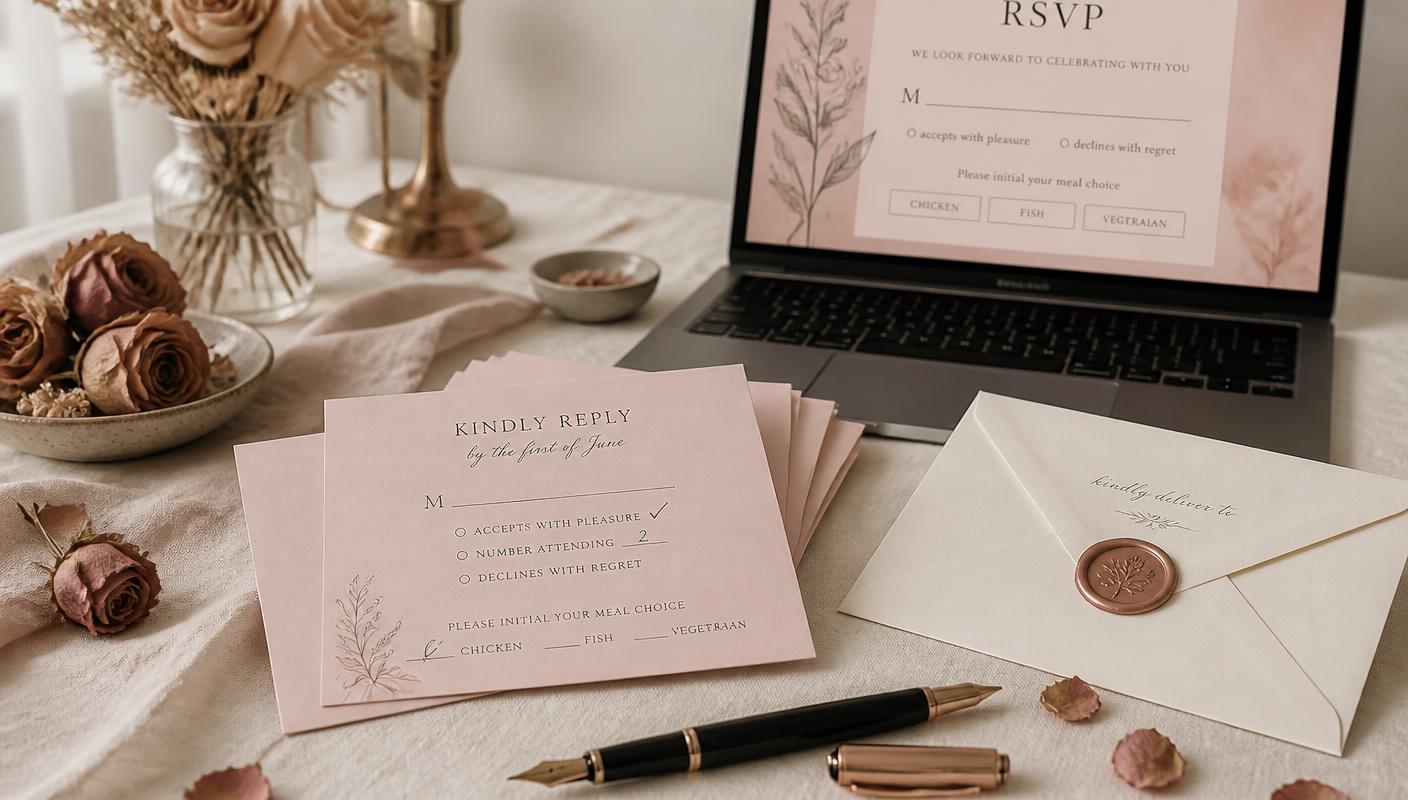
An RSVP looks like a courtesy. In practice it’s the single most operationally important piece of admin in your whole wedding — the thing your caterer, your venue, your transport and your seating plan all depend on.
This guide covers what to collect, how to word it, when to send it, and how to handle the awkward parts. Where the evidence is genuinely thin — and on RSVPs, a lot of it is — we say so rather than repeating industry folklore as fact.
1. What is a wedding RSVP, and why does it matter?
“RSVP” is shorthand for a request that invited guests confirm whether they are coming [9]. But the reply isn’t just a yes or a no. It’s the data source that drives your catering order, your seating plan, your children’s meals, your transport seats and, often, your accommodation allocation.
It also carries money. UK caterers and venues treat the final submitted numbers as a chargeable commitment: once you have confirmed a figure past the contractual cut-off, you generally pay for it whether the person turns up or not [17], [18], [19]. That is why a vague RSVP process is expensive, and why “they probably know we’re coming” is never a safe assumption.
2. What information should a wedding RSVP collect?
The list below is the core set. The design notes matter as much as the fields — a badly shaped question produces data you can’t actually use.
| Field | Why it's needed | Design note |
|---|---|---|
| Named guest and attendance status | Establishes the headcount used for catering, chairs, seating, drinks and favours | Present each invited person separately; avoid an unrestricted “number attending” field |
| Attendance for each event | Ceremony, wedding breakfast, evening reception and weekend events may have different capacities and suppliers | Show only the events that guest is actually invited to |
| Approved plus-one name | Converts an anonymous allowance into a person who can be seated, fed and contacted | Enable plus-one only for selected guests; never an open “add anybody” field |
| Meal choice per person | Required where the caterer offers advance selection; links each dish to a guest and seat | Ask only when the supplier genuinely needs pre-selection |
| Dietary requirement / allergy per person | Lets the caterer identify suitable meals and food-safety requirements | Separate allergies from preferences where practical; share only what the caterer needs |
| Children attending | Affects headcount, children’s meals, high chairs, seating and sometimes accommodation | Only display for households whose children are invited |
| Accessibility requirement | Allows step-free routes, seating, hearing support or a quiet space to be arranged | Ask what adjustment would help — never ask for a diagnosis |
| Transport / shuttle seat | Creates an operational passenger count where the couple provides transport | Ask each direction separately if outbound and return differ |
| Accommodation requirement | Useful only where you control a room allocation or need demand numbers | If guests book directly, give links and cut-off dates instead of collecting travel data |
| Contact details | Enables confirmation, reminders and urgent updates | Make clear whether email, mobile or both will be used |
| Song request or message | Optional engagement content, not core planning data | Keep optional; never let it block completion |
Hitched supports collecting meal choices, parking requirements and song suggestions [9], and Bridebook’s UK guest manager tracks RSVPs, dietary requirements, plus-ones, events and seating [12] — both commercial platforms selling planning tools, so treat their field lists as product scope rather than neutral advice. Guides for Brides recommends publishing venue postcode, timings, parking, taxis, accommodation and shuttle details [16]; those become RSVP questions only where the answer changes a booking or an allocation.
Three distinctions worth getting right
Adults, children and non-eating babies may need separate counts. Current UK catering terms can price age groups differently and often request dietary requirements alongside the seating plan [17].
Accessibility should be private and functional, and should cover the whole visitor route rather than just the entrance. Historic England advises checking the full route — toilets, alarms and staff support included [20] — and Scope lists transport, parking, step-free access, quiet areas, hearing loops and accessible toilets as the relevant questions [21].
Don’t collect accommodation data “just in case”. If you’re only recommending hotels, collect nothing. If you manage a room block or a shuttle, ask only what you need to administer it. That is the ICO’s data minimisation principle applied literally: data must be adequate, relevant and limited to your purpose [6]. Section 12 covers this properly.
For what it’s worth, this full set — per-event questions, per-person dietary and accessibility handling, named plus-ones and multi-event support — is what we build into the RSVP system on every site we make; you can see what’s included in each package.
3. How to word a wedding RSVP in the UK
Make the response action obvious
“Please respond by [date]” plus one clearly specified method — website, email or enclosed card. Hitched recommends making the route as frictionless as possible: a pre-stamped envelope, an email address, or a QR code [9].
State exactly who and what is invited
Distinguish full day, evening only, and any private event. Hitched is explicit that the invitation should say whether the recipient is invited to the whole day or the evening reception only [8]. Name the invited guests individually, so nobody RSVPs on behalf of a person who was never named [9].
State the children policy directly, and early
Leaving children’s names off is not a message — it’s an ambiguity. Hitched warns that omission alone is routinely misunderstood, and recommends explicit wording so parents have time to arrange childcare [10].
Digital wording doesn’t need a different tone
Hitched notes digital invitations can carry substantially the same formal or informal wording as print: basic details on the invitation, the full detail on the website [11].
Don’t import US conventions unexamined
A mandatory “M____” response line, or planning around a fixed national acceptance rate, is not supported as standard UK practice by anything we could find. Day guest versus evening-only guest is the distinction that actually matters in UK guidance [8]. Multi-event workflows — rehearsal dinners, welcome events, farewell brunches — are genuinely useful for destination or multicultural weddings, but they come from international platform products [13], not from any established British etiquette rule.
4. When should invitations and RSVPs be sent?
The working model that the UK guidance supports:
- Save-the-dates: 6–12 months before. Date and broad location only [8]. This is an editorial recommendation, not an observed average.
- Invitations: 2–3 months before. Hitched describes the tradition as 6–8 weeks but calls roughly 12 weeks more realistic where travel or accommodation is involved — while the same article summarises the advice as 2–3 months [8]. The inconsistency is theirs, and it tells you the number isn’t fixed.
- Destination weddings: 4–6 months minimum where possible [8].
- RSVP deadline: commonly 4–6 weeks before. Treat this as a range, not a rule. One current Hitched guide says 3–4 weeks [9]; another says 4–6 weeks [8]. Both are commercially motivated editorial content, and they contradict each other.
Immediately after the deadline, chase non-responders and validate names, event attendance, meals and requirements — before anything goes to a supplier.
5. How to set your RSVP deadline around supplier cut-offs
This is the part most guides skip, and it’s the part that actually determines your date. Your RSVP deadline should sit comfortably before your earliest supplier cut-off — and those cut-offs vary enormously.
| Supplier | Published cut-off | Note |
|---|---|---|
| Crown Hotel | 7 days before | Venue's own published terms |
| Saffron Event and Venue Caterers | Requested at 4 weeks; absolute deadline 2 weeks | Caterer's own terms and conditions |
| Blame Frank | 4 weeks before | Caterer's published timeline (Feb 2026) |
| The Sandy Cove Hotel | 6 weeks — or 2 months for exclusive use | Terms dated March 2024, older than two years |
Sources, in order: [22], [17], [18], [19].
One week to two months is not a rule; it’s a spread. That range plainly disproves any claim that UK caterers “always” need numbers by a fixed point. Read your own contract, find your earliest cut-off, then set your RSVP deadline two to three weeks earlier so you have time to chase. After the cut-off, additions may be impossible or chargeable, and reductions frequently aren’t refundable.
6. Digital versus paper RSVPs
| Dimension | Digital | Paper |
|---|---|---|
| Completion and admin | Immediate submission, validation, guest matching, automatic totals, exports and targeted reminders | Cards must be delivered, interpreted and manually transcribed |
| Cost | Often free or bundled with a website; bespoke systems may charge | Printing, envelopes, outbound postage and usually return postage — a standard letter is £1.80 First Class or 91p Second Class per direction |
| Changes | Form, schedule and instructions can be updated; guests can be pointed at current information | Printed details cannot change without a new communication |
| Guest experience | Convenient for many; must be mobile-friendly and offer an alternative route | Tactile, formal, and usable without a device; returning it takes more steps |
| Evidence | Greenvelope reports an 88.9% median wedding response rate on its own platform | No comparable UK paper dataset with the same denominator or method was found |
| Environmental claim | Hitched describes digital as a potentially greener choice | Uses physical materials and delivery, but no wedding-specific UK lifecycle study was found |
The postage figures are Royal Mail’s own published prices effective 7 April 2026: £1.80 First Class and 91p Second Class for a standard letter [15]. Printing, envelopes and return postage all sit on top of that, per direction.
On response rates: Greenvelope’s 2026 benchmark report — 70,624 events and 5.54 million invitations between July 2025 and June 2026 — found a median wedding response rate of 88.9%, with 80.9% of wedding responses being “yes” [14]. That is the strongest behavioural dataset we located, and it still cannot show that digital causes better responses. It is first-party data from a single non-UK platform that sells digital invitations, drawn from hosts using individually addressed invitations and reminders — and the publisher itself says those benchmarks probably exceed generic invitation performance [14]. No comparable UK paper-response dataset exists. Specific “digital improves response by X%” figures do appear on RSVP vendors’ own marketing pages; none of them rest on an independent UK comparison, and we would not treat them as fact.
The evidence-safe conclusion: digital offers clear administrative and cost advantages; paper offers formality, tangibility and offline accessibility. A hybrid — a paper invitation carrying a short URL or QR code, with a phone or paper fallback — is operationally plausible. What no reliable UK study tells us is which format UK guests actually prefer.
7. How to handle plus-ones and children
Ambiguous plus-ones
Use a named guest record with a per-invitation allowance, so an allowance becomes a person who can be seated and fed. If no plus-one was offered and a guest adds one anyway, reply politely that numbers are limited — don’t auto-add them and absorb the cost.
Guests replying for people who weren’t named
Require each named guest’s own status, plus their own meal and requirements. Hitched is explicit that guests should not RSVP for people whose names aren’t on the invitation [9].
Unexpected children on an adults-only invitation
Contact the parents directly. Hitched recommends a phone clarification where children have been entered despite an adults-only invitation [10] — assuming, in either direction, is how this goes wrong.
8. Dietary requirements, meal choices and accessibility
Collect meal choice per person only where your caterer actually offers advance selection, and record dietary requirements and allergies per person rather than as a household note. Separate genuine allergies from preferences where you can — they are different food-safety problems — and pass suppliers only what they need.
For accessibility, ask what adjustment would help rather than requesting a diagnosis, and think about the whole visitor route rather than the front door: toilets, alarms, staff support [20], transport, parking, step-free access, quiet areas and hearing loops [21]. Keep the answers private to you and the specific supplier who needs them.
The ICO treats dietary and access information in its own event process as special category data, collected using Article 6 consent alongside Article 9 explicit consent [2]. That is a strong official analogy for a commercial RSVP service — not proof that every food preference is automatically health data. Section 12 covers the implications properly.
9. What to do when guests do not RSVP
Hitched recommends waiting roughly a week after the deadline, then sending a gentle reminder; if silence continues, contacting the guest directly and explaining that final catering numbers are needed [9]. That is etiquette guidance rather than a measured optimum — Greenvelope’s 2026 dataset had not yet published its planned analysis of reminder effects [14].
A defensible escalation sequence:
- Wait about a week past the deadline.
- Send a gentle automated reminder.
- Follow up personally by text or phone.
- Give a firm decision deadline, and mean it.
Never treat silence as attendance. Hitched advises guests never to assume the couple “knows” they’re coming [9], and UK caterers treat final submitted numbers as a chargeable commitment [17], [18] — so a guessed yes is a paid-for empty chair.
10. How to manage last-minute RSVP changes
A “no” becomes a yes
Availability is not automatic once final numbers are in. Check capacity, the caterer and the seating plan before you accept.
A “yes” becomes a no
Acknowledge it, update the record and tell the affected suppliers — but be clear with yourself that charges may remain payable after the contractual cut-off [17], [19].
Last-minute additions
Never promise a place before the supplier confirms it. Plated meals are considerably less flexible than buffets, and extra guests affect staffing, equipment and service flow as well as food [18].
Dietary or access updates
Amend the master record and notify only the affected suppliers, promptly — then check whether menus, labels, seating or adjustments can still be changed at all.
11. How multi-event and evening-only RSVPs work
The best-supported approach is one guest identity, multiple event permissions, and a separate answer per event. Bridebook lets couples create events and allocate guests to them [12]; Joy uses guest tags or individual selection so guests only see the events they’re invited to and the questions relevant to them [13] — both commercial products, cited here as workable patterns rather than authorities.
The data model that follows from that:
- A guest or household record
- An invitation group
- An event entitlement per event: invited or not invited
- A separate response per event: yes, no, no response, or not required
- Event-specific meal, transport or access questions
- Separate day and evening headcounts
- A change history or last-updated timestamp
Two rules that matter more than they sound. Private event details should never be visible to uninvited guests — not hidden behind a scroll, genuinely not rendered. And for events that need no reply, label them “No RSVP required” rather than omitting the question and leaving the status ambiguous.
12. Wedding RSVP data and UK GDPR
Start with the reassuring part. The ICO states that personal data used for a purely personal or household activity, with no professional or commercial connection, falls outside UK GDPR’s scope [1]. A couple privately organising their own wedding is very likely covered by that exclusion — though unusual public or commercial reuse of the data could change the analysis.
A commercial wedding-website service does not inherit that exclusion just because its customers are couples. Where the couple decides what guest data is collected and why, and the service processes it on their instructions, the likely model is couple as controller and service as processor. Crucially, the role depends on the actual decisions being made, not on what a contract calls you [4]. If a service reuses guest data for its own analytics, advertising or product development, it becomes a controller for that separate processing.
What a service should actually be doing
- Document controller and processor roles, and give couples clear privacy information [4].
- Collect only fields tied to a real planning purpose — no optional profiling, no diagnosis questions [6].
- Treat access information and allergy or medical dietary information cautiously, because it may reveal health data; the ICO’s own event notice uses explicit Article 9 consent for exactly this [2], [3].
- Explain purpose, supplier sharing and retention to guests clearly, and share only what’s necessary with each supplier — a meal requirement plus a guest or table identifier, not the whole RSVP record.
- Use proper access controls, strong passwords, encryption where appropriate, confidentiality rules and documented breach handling [7].
- Set clear deletion or return rules after the event. The ICO sets no universal retention period; a business has to justify its own and securely delete or anonymise data once it’s no longer needed [7].
- Have an Article 28-compliant processor agreement covering instructions, confidentiality, security, subprocessors, rights assistance, breaches, audits and end-of-contract deletion or return [5].
One currency warning: several ICO pages are currently marked “under review” following the Data (Use and Access) Act changes, and the special category definition we rely on was last updated in April 2024 [3]. The domestic-purpose principle still stands, but treat the implementation detail as something to recheck rather than settled permanently.
13. Common RSVP claims the evidence does not support
These circulate widely, including on sites that sell wedding products. None of them is well supported, and we’d rather say so.
| The claim | What the evidence actually shows |
|---|---|
| “The UK RSVP deadline is X weeks before the wedding.” | There isn’t one. Current Hitched pages say 3–4 weeks in one guide and 4–6 in another [8], [9], and supplier contracts range from one week to two months [19], [22]. |
| “Digital RSVPs get better response rates than paper.” | No reliable UK study compares the two. The only strong dataset is first-party, non-UK and from a company selling digital invitations [14]. |
| “X% of guests don’t reply / decline / change at the last minute.” | No robust UK statistic for RSVP response, decline, non-response or last-minute change rates was found. Any specific figure is invention. |
| “Digital invitations are greener.” | Plausible, and stated by Hitched [11], but unquantified — no wedding-specific UK lifecycle assessment was located. |
| “Going digital improves responses by X percentage points.” | Found on RSVP vendors' own marketing pages, with no independent UK comparison design behind it. Not verified. |
| “UK caterers always need final numbers two weeks out.” | Directly contradicted by published terms: 7 days, 2 weeks, 4 weeks, 6 weeks and 2 months all appear [17], [18], [19], [22]. |
There are also things nobody appears to have measured, and we won’t fill the gaps with estimates: nationally representative UK guest preference between paper, digital and hybrid; any controlled UK comparison of completion rate or response speed by medium; UK rates for unauthorised plus-ones or no-shows; a national average venue final-numbers deadline; whether song-request questions improve completion at all; how reliable household-level replies really are; and any published disability-led research testing wedding RSVP wording specifically.
Sources
- [1]ICO, “A guide to the data protection exemptions”, https://ico.org.uk/for-organisations/uk-gdpr-guidance-and-resources/exemptions/a-guide-to-the-data-protection-exemptions/, undated — accessed 26 August 2026.
- [2]ICO, “Attend an event, seminar or workshop (privacy notice)”, https://ico.org.uk/global/privacy-notice/attend-an-event-seminar-or-workshop/, undated — accessed 26 August 2026.
- [3]ICO, “What is special category data?”, https://ico.org.uk/for-organisations/uk-gdpr-guidance-and-resources/lawful-basis/special-category-data/what-is-special-category-data/, updated 9 April 2024 (older than two years).
- [4]ICO, “How do you determine whether you are a controller or processor?”, https://ico.org.uk/for-organisations/uk-gdpr-guidance-and-resources/controllers-and-processors/controllers-and-processors/how-do-you-determine-whether-you-are-a-controller-or-processor/, undated — accessed 26 August 2026.
- [5]ICO, “What needs to be included in the contract?”, https://ico.org.uk/for-organisations/uk-gdpr-guidance-and-resources/accountability-and-governance/contracts-and-liabilities-between-controllers-and-processors-multi/what-needs-to-be-included-in-the-contract/, undated — accessed 26 August 2026.
- [6]ICO, “Principle (c): Data minimisation”, https://ico.org.uk/for-organisations/uk-gdpr-guidance-and-resources/data-protection-principles/a-guide-to-the-data-protection-principles/data-minimisation/, undated — accessed 26 August 2026.
- [7]ICO, “Data storage advice”, https://ico.org.uk/for-organisations/advice-for-small-organisations/information-security/data-storage-advice/, undated — accessed 26 August 2026.
- [8]Hitched, “When to Send Save the Dates & Wedding Invitations”, https://www.hitched.co.uk/wedding-planning/invite-wording-and-etiquette/when-to-send-wedding-invitations-save-the-dates/, updated 14 January 2026 (commercial marketplace guidance).
- [9]Hitched, “What Does RSVP Mean?”, https://www.hitched.co.uk/wedding-planning/invite-wording-and-etiquette/what-does-rsvp-mean/, updated 24 March 2025 (commercial marketplace guidance).
- [10]Hitched, “No Children at Wedding Wording”, https://www.hitched.co.uk/wedding-planning/invite-wording-and-etiquette/no-children-at-wedding-wording/, updated 3 March 2026 (commercial marketplace guidance).
- [11]Hitched, “Online Wedding Invitations”, https://www.hitched.co.uk/wedding-planning/invite-wording-and-etiquette/wedding-e-vites/, updated 31 March 2025 (commercial marketplace guidance).
- [12]Bridebook, “Wedding Planning Guest List”, https://bridebook.com/uk/wedding-planning-tools/guestlist, undated — accessed 26 August 2026 (commercial UK platform).
- [13]Joy, “Manage RSVPs and schedules for multiple events”, https://withjoy.com/help/en/articles/11085588-how-can-i-use-joy-to-manage-rsvps-and-schedules-for-multiple-events-when-not-everyone-is-invited-to-every-event, 8 August 2025 (non-UK commercial platform).
- [14]Greenvelope, “RSVP Response Rate Statistics 2026”, https://www.greenvelope.com/resources/rsvp-response-rate-benchmarks, updated 21 July 2026 (first-party, non-UK platform data).
- [15]Royal Mail, “Stamp prices from 7 April 2026”, https://mymailingroom.com/wp-content/uploads/2026-stamp-postage-prices-Royal-Mail-april-2026.pdf, created February 2026.
- [16]Guides for Brides, “How to Organise Wedding Guest Transport and Accommodation”, https://www.guidesforbrides.co.uk/wedding-ideas/for-your-guests-accommodation-taxis, updated 12 May 2026 (commercial UK directory).
- [17]Saffron Event and Venue Caterers Ltd, “Terms and Conditions”, https://saffronoutsidecatering.co.uk/wp-content/uploads/2026/05/Saffron-Terms-and-Conditions-2025.pdf, accessed 26 August 2026 (single supplier's own contract).
- [18]Blame Frank, “A realistic timeline for wedding and event catering”, https://blamefrank.co.uk/event-catering-timeline/, 8 February 2026 (single supplier's own guidance).
- [19]The Sandy Cove Hotel, “Wedding Terms & Conditions”, https://sandycove-hotel.co.uk/sites/default/files/2024-03/Wedding%20Terms%20%26%20Conditions.pdf, March 2024 (older than two years).
- [20]Historic England, “Easy access to historic buildings — checking the visitor route”, https://historicengland.org.uk/advice/technical-advice/easy-access-to-historic-buildings/, undated — accessed 26 August 2026.
- [21]Scope, “Accessible events and venues guidance”, https://www.scope.org.uk/advice-and-support/accessible-events, undated — accessed 26 August 2026.
- [22]Crown Hotel, “Wedding terms and conditions (final numbers)”, https://www.crownhotelboroughbridge.co.uk/weddings/, accessed 26 August 2026 (single supplier's own contract).
Want your RSVP handled properly, without having to think about all of this?
Named guests, per-event entitlements, dietary and accessibility data treated with care, reminders sent for you, and numbers ready before your caterer asks for them. We build it, we run it, and we keep it right — so the only RSVP decision left to you is where everyone sits.
Make an enquiry